

Marriage After 30: What Every Woman Should Know About Fertility, Relationships & Future Planning
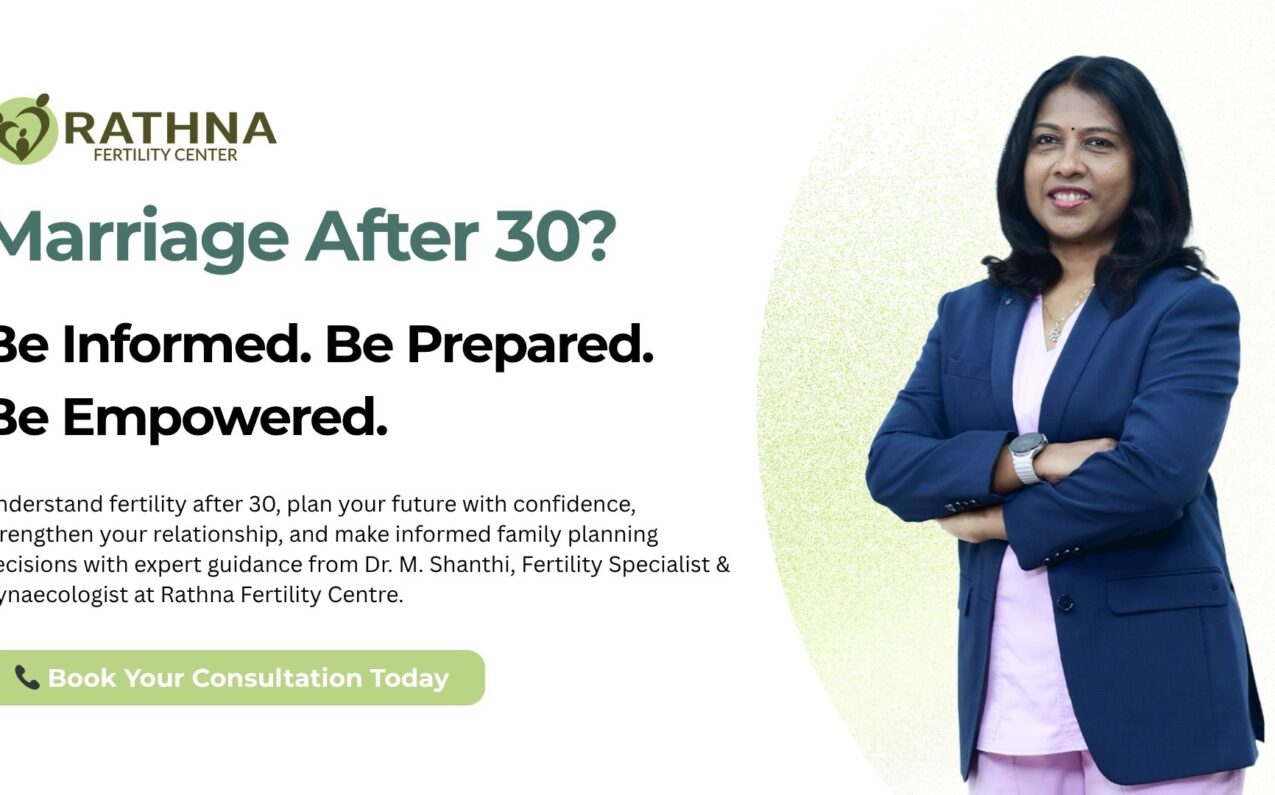
By Dr. M. Shanthi| Fertility Specialist & Gynaecologist Rathna Fertility Centre, Kanyakumari, Tamil Nadu
“Age is just one part of the story. What truly matters is awareness, preparation, and making informed decisions about your future.”- Dr. M. Shanthi
In today’s world, more and more women are choosing to marry after 30 – and that is a completely valid, often deeply considered decision. Career, education, personal growth, finding the right partner – life doesn’t always follow a fixed timeline, nor should it have to.
But here is something equally important: knowing the facts. Understanding what changes in your body after 30, how it may affect your fertility, what to prepare for in a relationship, and what practical steps you can take – this knowledge is not a reason to panic. It is a reason to feel empowered.
I recently spoke about this topic in a special Women’s Health Talk session, and the response was overwhelming. So many women had the same questions, the same concerns, the same unspoken worries. This blog is my way of putting those answers in one place – clearly, honestly, and with compassion.
Let me begin with the most common concern I hear in my clinic: “Doctor, I am 32 – is it too
late?
A woman is born with all the eggs she will ever have. From puberty, that reserve gradually declines. In your 20s, egg quantity and quality are at their peak. After 30- particularly after 35- the decline becomes more noticeable, both in the number of eggs and their chromosomal quality.
This does not mean conception is impossible after 30. Millions of women around the world have healthy pregnancies and babies in their 30s and beyond. What it does mean is that timing and health awareness become more important.
- Egg reserve begins to decline more noticeably after 35, a phase sometimes called the
“fertility cliff”- though this is gradual, not sudden - The risk of chromosomal conditions such as Down syndrome increases with
maternal age, which is why antenatal screening becomes more important - Conditions like PCOS, endometriosis, or fibroids – which may have been silent in your 20s- can become more impactful on fertility in your 30s if left unaddressed
- AMH (Anti-Müllerian Hormone) testing can give you a clear picture of your ovarian reserve – a simple blood test I recommend to every woman over 30 who is planning for a family
- Get a fertility health check – don’t wait until you are trying to conceive. A baseline assessment gives you clarity and options.
- Track your menstrual cycle – irregular periods can be an early signal of hormonal imbalance
- Maintain a healthy weight– both underweight and overweight conditions affect hormone balance and ovulation
- Quit smoking and limit alcohol – both are proven to affect egg quality
- Start folic acid supplementation – ideally 3 months before you plan to conceive
Marriage after 30 often comes with a clearer sense of self, stronger communication skills, and a better understanding of what you need in a partner. These are real advantages. But they also come with new conversations that need to happen – openly and honestly.
- Do we want children? When? This is non-negotiable. Both partners need to be on the same page – not just about whether they want children, but when, how many, and what they would do if conception is difficult.
- Have we both had a fertility health check? Male factor infertility contributes to nearly 50% of all cases. Before assuming the issue lies with the woman, both partners should be evaluated. A semen analysis for the male partner and an AMH/ovarian reserve test for the female partner are excellent starting points.
- What are our values around assisted reproduction? If natural conception takes longer than expected, are both partners open to IUI, IVF, or other forms of assisted reproduction? This conversation is better had before it becomes an urgent one.
- How do we handle stress together? Fertility journeys – when they are challenging- can put enormous pressure on a relationship. A couple that communicates well and supports each other is far better equipped to navigate this path.
- Are our lifestyle habits aligned? Sleep, nutrition, exercise, stress management- these affect both fertility and long-term health. Couples who build healthy habits together fare better, in fertility and in life.
Part 3: Practical Steps for Future Planning
Whether you are already married, recently engaged, or simply thinking ahead – here are the practical steps I recommend to every woman in her 30s.
Step 1: Book a Pre-Conception Health Check
A pre-conception consultation covers your menstrual health, hormonal profile, ovarian reserve, thyroid function, blood sugar levels, and BMI. It gives you a personalised roadmap - and it takes just one appointment to get started.
Step 2: Know Your Numbers -AMH & AFC
AMH (Anti-Mullerian Hormone) and AFC (Antral Follicle Count, measured via ultrasound) are the two most reliable indicators of ovarian reserve. These tests tell us how many eggs you likely have and how your body may respond to fertility treatment if needed.
Step 3: Consider Egg Freezing
If you are not yet ready for a family but want to preserve your options, egg freezing (oocyte cryopreservation) is a medically proven way to protect your fertility. Eggs frozen in your early 30s retain the quality of that age- giving you more flexibility later.
Step 4: Address Any Underlying Conditions
PCOS, thyroid disorders, endometriosis, and uterine fibroids are among the most common conditions affecting fertility in women over 30. Many of these are manageable - but only if diagnosed. Don't delay evaluation because you have no symptoms; some conditions are silent.
Step 5: Don't Wait Too Long to Seek Help
If you have been trying to conceive for 12 months without success (or 6 months if you are over 35), please do not wait further. Come in for an evaluation. Early intervention gives far better outcomes than waiting.
A Message From Me - Dr. M. Shanthi
I have sat across from hundreds of women in my clinic – women who were scared, confused, or simply wished someone had told them these things earlier. That is why I speak about this openly, and that is why I created this Women’s Health Talk.
Marriage after 30 is not a medical risk. It is a life choice. But like all important choices, it is best made with the right information. Whether you are planning to start a family soon, years from now, or are unsure – please do not let uncertainty keep you from seeking clarity.
My door – and my team’s door – is always open.
Consult Dr. M. Shanthi at Rathna Fertility Centre
If this blog raised questions for you – about your fertility, your health, or your future – I
invite you to come in for a personal consultation. There is no question too small, and no
concern too early to address.
Rathna Fertility Centre (Rathna Memorial Hospital) 11-208, Swamiyarmadam,
Kattathurai Kanyakumari District, Tamil Nadu – 629 158